
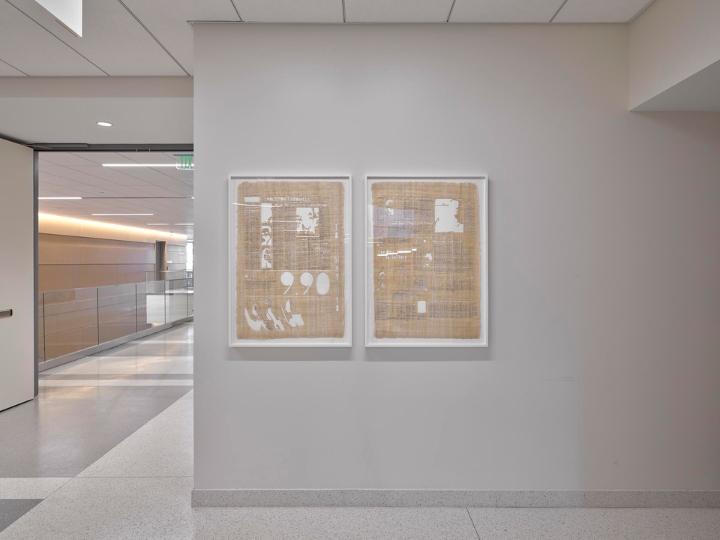
Jamal Cyrus’ Eroding Witness, Episode 3 Season 20 is located in the John M. O’Quinn Law Building on the University of Houston campus. Photo by Will Michels.
Jamal Cyrus, a Houston-based artist and graduate of the University of Houston, was recently awarded a 2023 Guggenheim Fellowship in the Fine Arts category. A total of 171 scientists, writers, scholars and artists from 48 disciplines were honored and selected from almost 2,500 applicants for their promise to enrich the lives of fellow human beings through their research and work.
Cyrus’ artworks examine and illuminate the political history and visual culture of Black America through collage and assemblage. He uses ordinary materials and processes to provide a deeper understanding of the issues Black Americans have faced and are currently facing.
In 2004 he graduated from UH with a Bachelor of Fine Arts with a focus on photography and digital media. In 2008 he graduated with a Master of Fine Arts from the University of Pennsylvania. His work has been shown across the country and world, including here at UH. His play “Eroding Witness, Episode 3, Season 20” will be screened at the John M. O’Quinn Law Building. His exhibition The End of My Beginning premiered at UH’s Blaffer Art Museum in 2021 and has subsequently been shown at the Institute of Contemporary Art, Los Angeles and the Mississippi Museum of Art.
We spoke to Cyrus about his award, his time at UH, his artwork and his future.
What went through your mind when you found out you received a Guggenheim Fellowship?
In a strange way, I was relieved. Relief at what the scholarship will enable me to do in the studio. It allows me to be a little more adventurous in the studio than I might have before. At the same time, I felt very honored to be part of a roster of artists to have received a Guggenheim Award, which is quite an outstanding cast.
What research will you do as part of your fellowship?
Black American music has a global influence as seen through blues, jazz, R&B, etc. My research will ask the question how to take aspects of this music, the principles of this music, conceptual ideas within this music and then transform it or translate it into visual form?
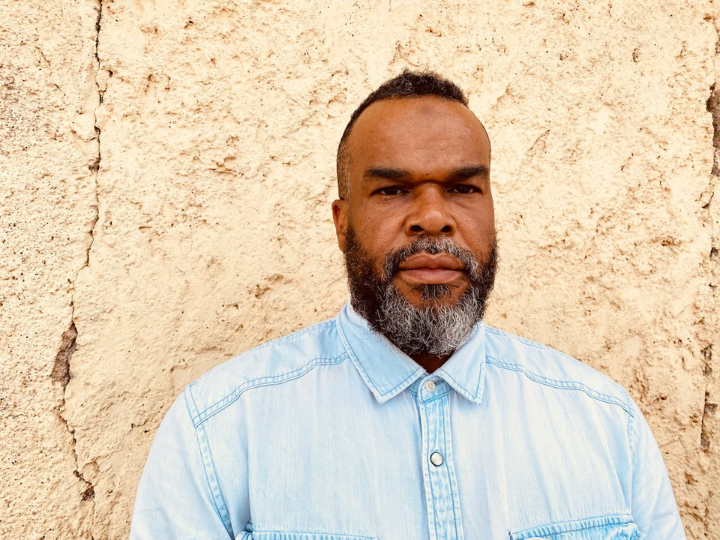
Graduated with a major in photography and digital media.
What was your time as a student at the University of Houston like?
That was a discovery phase in my life. You really had the opportunity to express yourself about what you do and what it’s about. At UH I learned to express myself and talk about my work.
I also think that the block program at the University of Houston (which is an intensive “block” of semesters for fine arts majors enrolled in studio courses at the junior and senior levels) is the perfect graduate school education. I had to be self-determined and self-directed when it came to describing what my projects were about. That helped me alot.
Tell me about your feature “Eroding Witness, Episode 3, Season 20” that was shown on campus.
A lot of my work deals with a certain aspect of American history that is often overlooked. Since I was at UH, I started to really get into black political history. Very often you hear about New York, Chicago, Los Angeles, but not really much about Houston. So I started visiting local archives and finding out who some of the key players in Houston’s civil rights struggle were. At the Houston Metropolitan Research Center I found this story about an activist associated with the Student Nonviolent Coordinating Committee in Houston and it appears that the activist, Lee Otis Johnson, was involved in a drug affair and ended up serving a 30 year sentence received punishment for passing a marijuana cigarette to an undercover cop.
As far as I know, he did not distribute or sell this cigarette, just shared it with others. And the real reason he was targeted was his work as a political activist.
That told me that the same things were happening in Houston that were happening in these other cities. It’s just that these stories aren’t talked about in the same way and aren’t written in the same way. I felt compelled to change something about this story and this work.
Why did you use diptych and papyrus, which are religious media, for the piece?
For me there is a connection between black resistance and black politics and spirituality. Papyrus has a connection to ancient Egypt, which is of course in Africa. Another thing to know about papyrus, especially ancient papyrus, is that it can erode. What I wanted to emphasize in this piece is the erosion, collapse or oblivion of these individuals and these stories.
Why is “Season 3, Episode 20” in the title?
I really wanted people to feel like this is part of a long, episodic story that has been forgotten.
What are you working on now?
I’m working on a public artwork with artist Charisse Weston. We are making a memorial glass sculpture for Barbara Jordan to be placed at the Gregory School in Houston’s Freedman’s Town.
Post a Comment